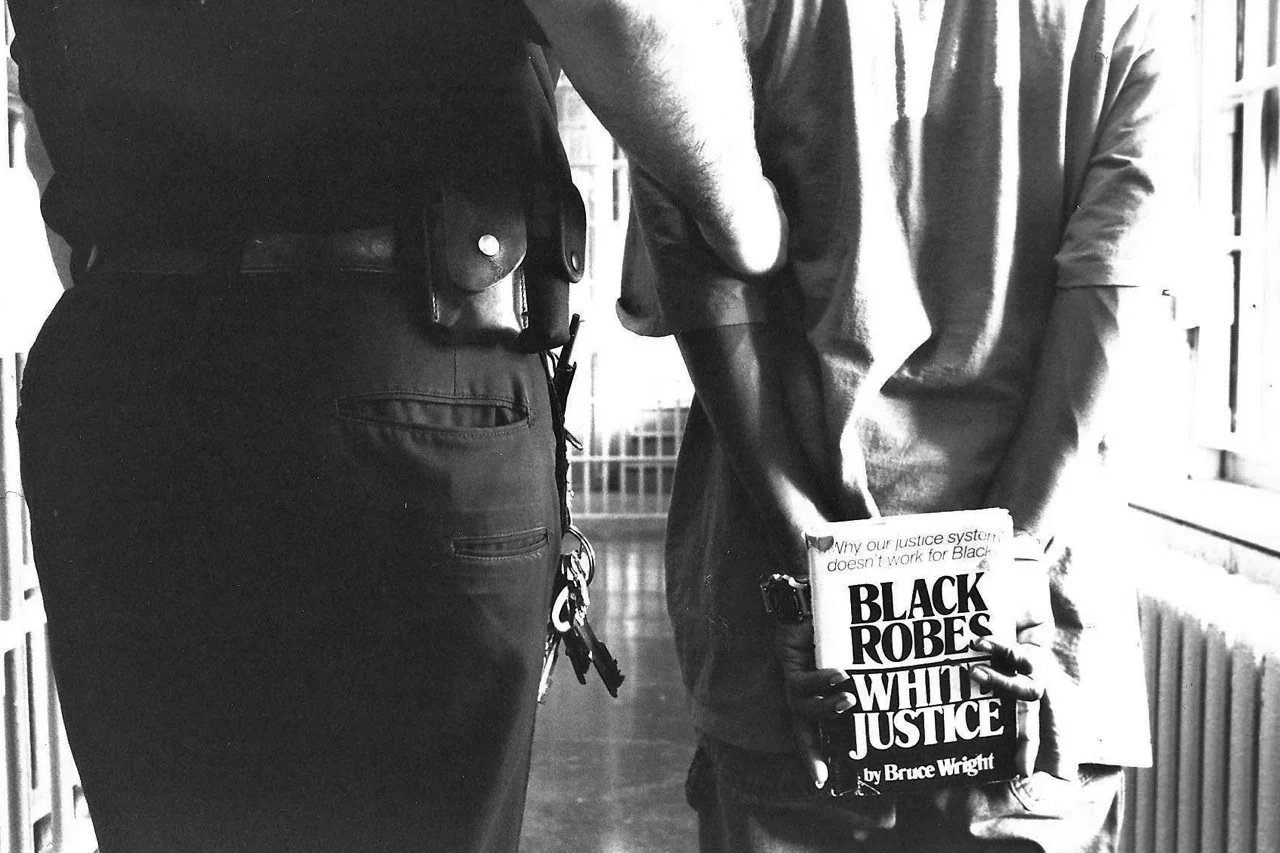

THE TOMBS

Words by fayemi shakur l Images by Akintola Hanif

You can't separate peace from freedom because no one can be at peace unless he has his freedom. – Malcolm X

Even though some people know African Americans make up 13.6 percent of the U.S. population (according to census data), they may not realize that Black men reportedly comprise 40.2 percent of all prison inmates. Most people assume those who are locked up are criminals, or weak-minded, and must have done something wrong. Filmmaker Jerry LaMothe is determined to show another point of view, one that is partially based on his own brief experience in jail. “I was locked up for something really petty that had a significant effect on my life. My experiences being in that cell and the people I met in jail all came back to me,” he explains.

Coming off the heels of a few award-winning feature films, including the film Blackout which starred Jeffrey Wright, 38 year-old LaMothe wanted to create a project to engage others in a conversation about the prison system and the injustice that exists. “I wanted to do something that was socially relevant and profound. My team thought it would be a good idea to do a short. I was skeptical at first, especially after coming out the gate with several successful feature-length projects. But for creative people whether it’s for work or if it’s for free you always need to express yourself in the interim of those gaps or you can go crazy,” says LaMothe.

LaMothe and his team produced The Tombs, a short drama shot in the Essex County jail in Newark. The film is about a man unjustly accused of a crime who finds himself spending several days in Manhattan’s Detention center (known as The Tombs,) while waiting to see a judge to find out his fate, the lead character thinks about what justice is and why so many men accept jail as a dysfunctional rite of passage. “Just because you grow up a certain way and try to stay out of trouble doesn’t mean it doesn’t happen. And not everybody who is in jail has really done what they are accused of. There are a lot of gray areas. As artists we put things in our memory banks and you know you’re gonna use it for motivation or inspiration and it came back. As a Black man who has a young son I’m concerned about the state of the prison system and the overpopulation of prisoners, which is more than any country in the world,” says LaMothe.

Sometimes it’s not always about solving the problem but raising awareness.

Earlier this year Corrections Corporations of America (CCA), which owns and manages prisons and detention centers, offered prison officials in 48 states a 20-year contract if prison officials could guarantee prisons would be at least 90% full. Angry organizations argue that CCA’s proposed contractual obligation is a poor public policy that could force communities into creating criminals. How can prison officials “guarantee” 90% occupancy? CCA is known to spend millions of dollars lobbying for stricter laws to support its interest and has spent over $14 million between 2003 and 2010 on lobbying alone.

Last year, Michelle Alexander, author of The New Jim Crow: Mass Incarceration in the Age of Colorblindness shared another sad fact – there are more Black men in prison or on probation or parole than there were slaves in 1850. All of this proves LaMothe’s point that the prison industrial complex is big business. In addition to being isolated from loved ones and, in too many cases, exposed to inhumane conditions –in one of the wealthiest countries in the world--prisoners also provide labor for corporations for below minimum wage. There never seems to be a genuine effort to rehabilitate prisoners; end harsher sentencing for Black and Latino people, or change the factors that lead to incarceration, like poverty, unemployment and racism.

“It’s so easy to get hit over the head and caught up. Outside of getting accolades for our projects, my collective is passionate about the subject itself. Many educators and teachers have asked us to come out and speak to their schools because they feel the young men in their classes need to see it. I’m all for that,” says LaMothe explaining his reasons for making The Tombs. “One thing is clear, our current system is not working and they set you up for failure. That’s why we have the revolving door. I want to provide a social service and use this film to speak to young men and forewarn them,” says LaMothe.

Recently, The Tombs won Best Short Film and will receive a 2012 Paul Robeson Award from The Newark Museum https://www.newarkmuseum.org/nbffrobesonawards.html in conjunction with its annual Black Film Festival. A screening will be held on Aug. 1st. LaMothe also plans to go on a college tour and do more screenings of the project.

Buy HYCIDE in print
HYCIDE cover
HYCIDE cover
HYCIDE cover
HYCIDE cover
HYCIDE cover
HYCIDE cover
HYCIDE cover
HYCIDE cover
HYCIDE cover
HYCIDE cover

HYCIDE explores the roles we create for ourselves and those created for us, challenging the status quo while bearing witness to the feared, neglected and misunderstood.

Our Mission: Stories of survival and freedom. No judgment.

    READ MORE FROM HYCIDE MAGAZINE