
Negro Removal
Words by John Johnson Jr
Images by Manuel Acevedo
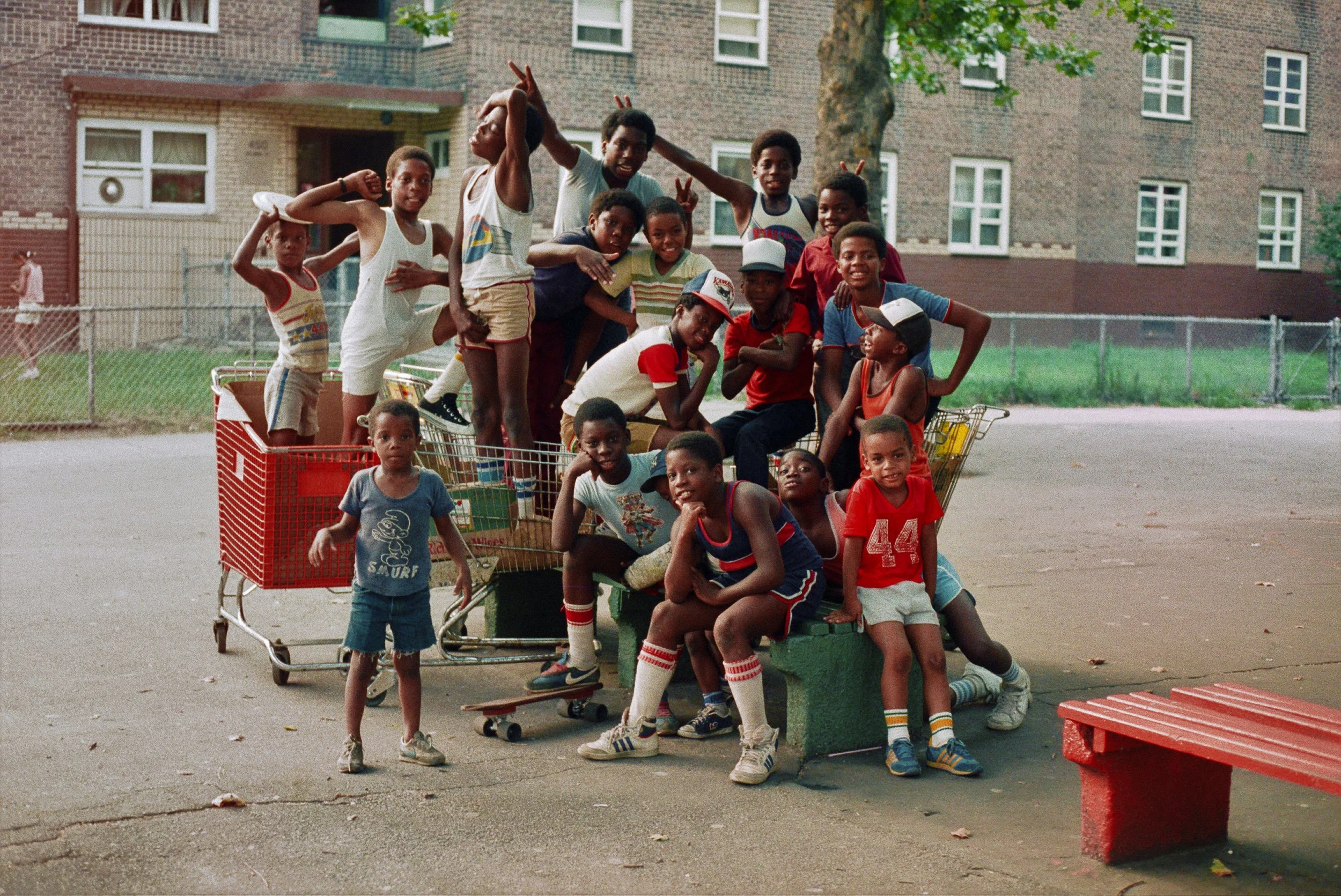
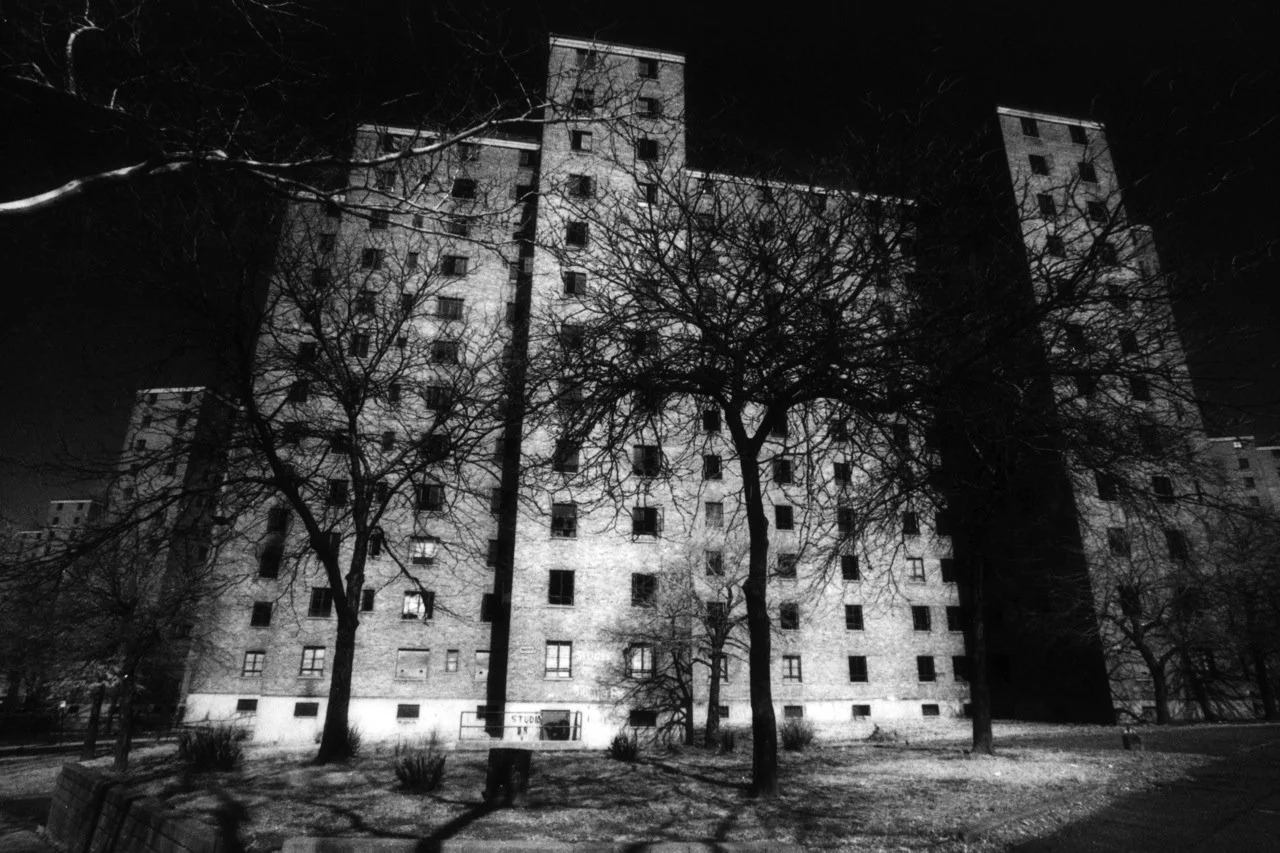
In 1987, Newark officials and invited guests sat atop grandstands to view the demolition of the Edward W. Scudder Homes, one of four high-rise housing projects in the city. The cheers of onlookers punctuated the din of the imploding buildings. For many years, the projects symbolized all that was wrong with the city: crime, poverty, destitution, and abandonment. But the joy expressed at their destruction belied the sincere hopes of hundreds of Central Ward Newarkers. Thirty years earlier those residents had been optimistic about projects like the Scudder Homes, which once offered the promise of safe, affordable housing for Newark’s poor Black residents.
The rise and fall of high-rise public housing is a tragedy that unfolded in cities across America during the postwar years, thanks to the complicity of federal lawmakers, local political figures, and developers, who exploited housing regulations for their own gain. In Newark, the result was federally subsidized ghettos planted in the center of a de-industrializing city. High-rise projects displaced Black residents, sectioned them off from Newark’s downtown business district, and played an instrumental role in the city’s segregation. Post-World War II public housing was a domestic policy of containment, according to historian Arnold Hirsch. Its legacy determined the city’s landscape for decades to come, shaping the social and economic dynamics of present-day Newark and the larger metropolitan area.
Newark’s first foray into federally subsidized housing began during the waning years of the Great Depression. The federal Housing Act was approved in 1937 to address a shortage of “decent, safe, sanitary dwellings” for low-income families. The Newark Housing Authority (NHA) was created to oversee the planning and construction of several two- and three-story apartment complexes, often built on vacant land in or near Newark’s White ethnic neighborhoods. Constructed in part to win votes from the city’s European immigrant communities, the complexes were strictly segregated until the late 1940s, when White residents began to migrate to the suburbs.
Stephen Crane Village, home of Frankie Valli and the Four Seasons of “Jersey Boys” fame, was built near the Italian First Ward, along the Belleville border, in 1940. Seth Boyden Homes, built in 1941, housed an increasingly Jewish community along Frelinghuysen Avenue. Bradley Court, on Newark’s chiefly Irish West Side, housed a polyglot cohort of working-class Catholics. No federal funds were spent to improve the dangerous, dilapidated housing of the Third Ward, also known as The Hill. Home to the city’s poorest Black residents, the Third Ward had some of the highest rates of tuberculosis and infant mortality in the city. That was due in part to a widespread lack of indoor plumbing, the use of coal-burning stoves, and poor ventilation.
Newark author Curtis Lucas vividly described life there. “It is a slum area, and blighted… women and children stand in the doorways of tumbling, roach-infested houses,” he wrote in “Third Ward Newark,” a prophetic 1946 novel that recounted the poverty and racial tensions in the city. Newark’s antidote to the Third Ward’s wretched living conditions was to raze the district to make way for downtown business development and a new wave of public housing: high-rise projects. The latter were built after the federal government instituted a new plan for affordable housing in the wake of World War II. The Housing Act of 1949 promised “a decent home and a suitable living environment for every American family,” but it overwhelmingly benefited Whites. The federal government underwrote suburban development, inducing banks to provide low-interest loans to White homebuyers. As for Blacks, until the late 1960s they were effectively banned from moving to the suburbs because White homeowners refused to sell to them, banks denied them loans, and realtors refused to show them property.
While government policies encouraged Whites to flee to the suburbs, the federal government also funded slum clearance projects and encouraged the construction of high-rises, which concentrated the city’s impoverished residents, most of them Black, into one area. Unlike pre-war public housing in Newark, which was dispersed throughout the city, the high-rises were built on massive superblocks in the heart of the Central Ward. Modern public housing effectively cordoned off poor Black residents from the city’s central business district, preserving downtown for white-collar commuters, who lived in the surrounding suburbs.
Many high-rise tenants were required to meet strict income requirements, ensuring that public-housing residents would be mostly poor. And in post-war Newark, the poor were increasingly Black. As many of the Italian, Irish, and Jewish residents of pre-war public housing left Newark to buy homes in the suburbs, thousands of Southern Blacks arrived during the Great Migration. While the overall population of Newark declined from 1950 to 1960, the city’s African American population nearly doubled from roughly 75,000 to nearly 140,000. But Southern Blacks arrived in a city bereft of the good-wage, low-skilled jobs that a generation earlier had supported White ethnic Newarkers.
They also made up many of the 8,000 families displaced when obsolete buildings in the Third Ward were demolished, along with a host of churches, Black- and Jewish-owned businesses, jazz clubs, and speakeasies. The government referred to it as “urban renewal,” but Blacks called it “Negro removal.”
From 1955 to 1962, Newark saw the construction of the Christopher Columbus Homes, the Stella Wright Homes, the Rev. William T. Hayes Homes, and the Scudder Homes. They boasted heat, indoor plumbing, and fire-resistant construction, but there were not enough units to accommodate the displaced. Newark housing officials made inadequate plans to house residents who had been forced from their homes. The displaced residents had little choice but to rent apartments in Newark’s South, Central, and West wards, where unscrupulous landlords often doubled and tripled their monthly rent and subdivided properties to rake in more cash, resulting in overcrowding.
For African Americans, urban renewal was a 20th-century Trail of Tears. But for city developers, it was a windfall, fueled by local officials who catered to their needs. The developers received federal loans to build impressive residential towers, such as the Colonnades near Branch Brook Park and Weequahic Towers in the South Ward. Designed to retain middle-income residents, these new towers filled Newark’s skyline even as the Stella Wright, Scudder, Columbus, and Hayes homes fell into disrepair through the 1960s. Housing project residents tried to fight back. In 1970, tenants of the Stella Wright, Columbus, and Scudder homes staged what would become the longest rent strike in American history. In total, 11,000 people withheld $6.5 million in rent. The four-year strike garnered temporary victories for project residents, including some court-ordered apartment renovations and tenant management at Stella Wright. But public housing continued to deteriorate as the housing authority failed to follow through on court mandates to maintain the high-rises. Throughout the 1980s, the NHA remained a source of patronage and graft. The high-rises were doomed.
Between 1987 and 1999, the NHA demolished four high-rise projects. One tower remains in Newark: the Geraldine “Gigi” Foushee Towers, which houses seniors and disabled persons and was once part of Scudder Homes. In the mid-2000s, the city announced plans to replace Newark’s low-rise pre-war projects with mixed-unit, mixed-income housing. If the plans are realized, the last vestige of America’s 20th-century campaign to build a decent home for all will be gone. “This is the end of an American dream that failed,” Newark Mayor Sharpe James lamented at the ceremony marking the demolition of the Columbus Homes in 1994. But throughout the 20th century, local politicians, developers and the federal government ensured that for the majority of Newark’s African Americans, access to a decent home would be a dream demolished.
HYCIDE explores the roles we create for ourselves and those created for us, challenging the status quo while bearing witness to the feared, neglected and misunderstood.
Our Mission: Stories of survival and freedom. No judgment.
READ MORE FROM HYCIDE MAGAZINE