
SUBJECT LINE
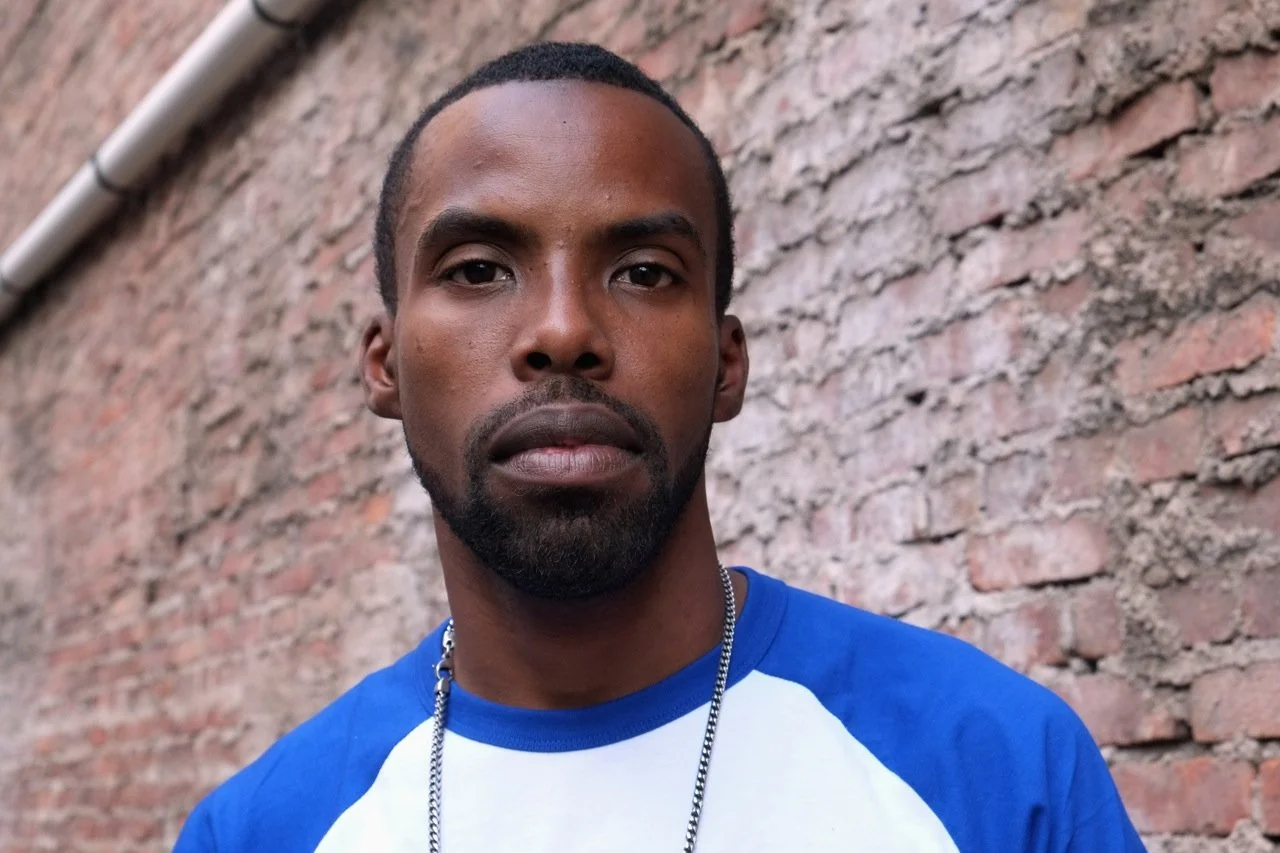
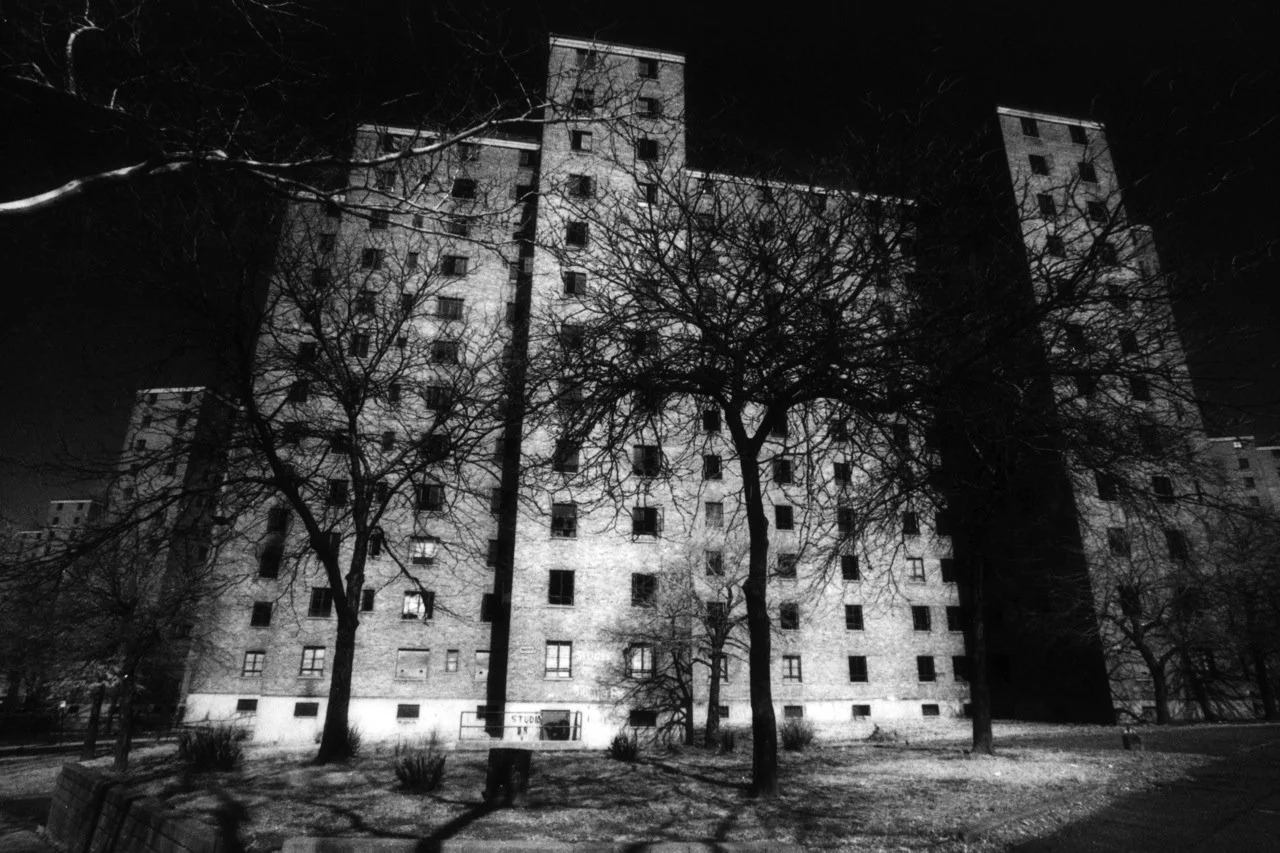
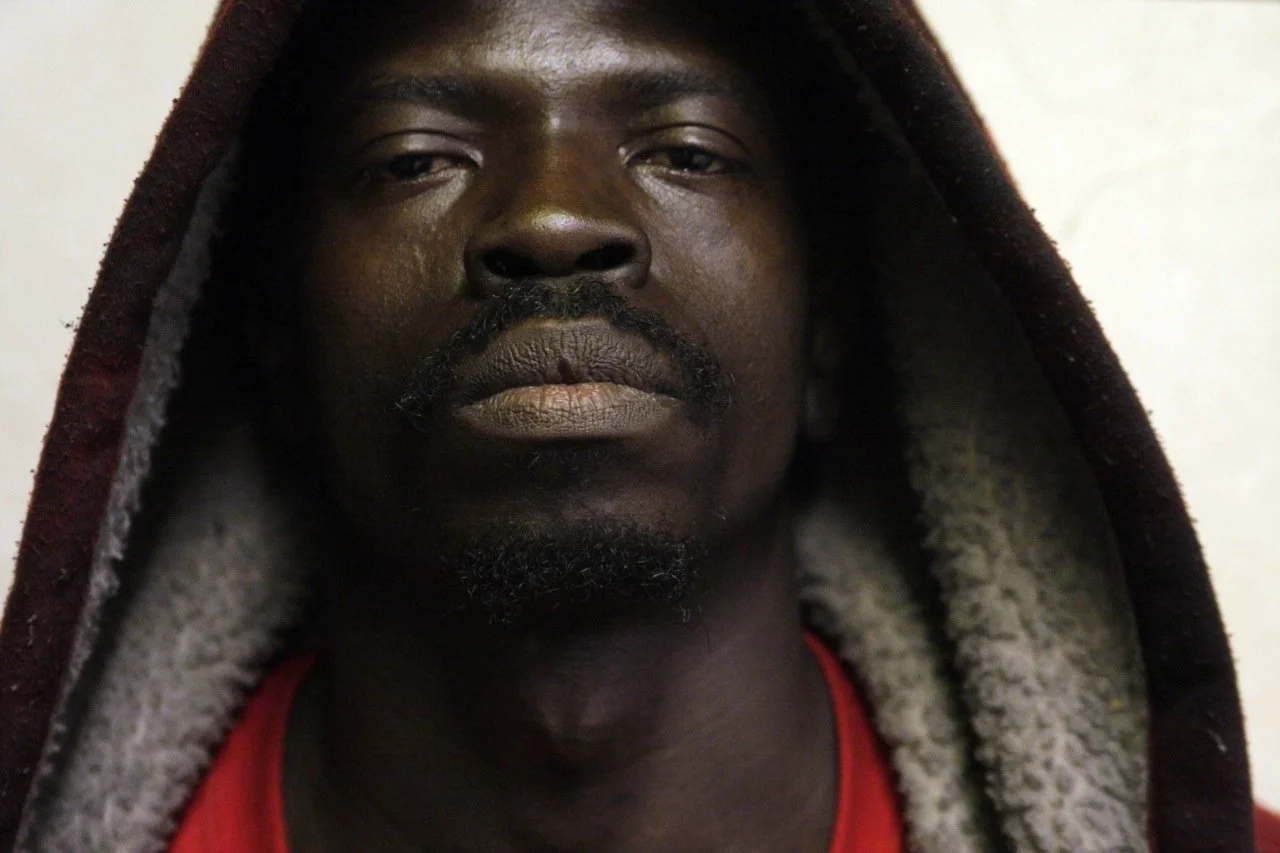
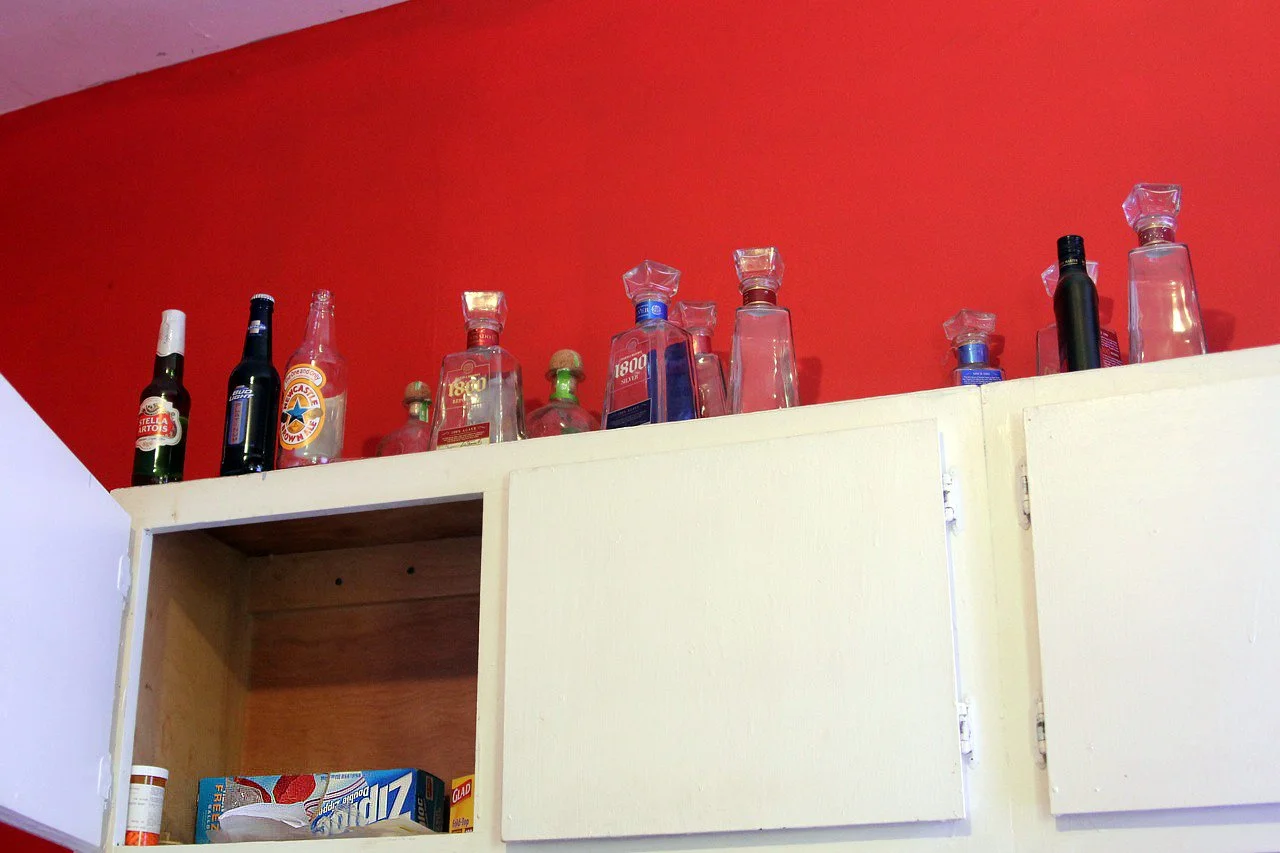
Words by Lucy Mckeon | Images by Ruddy Roye
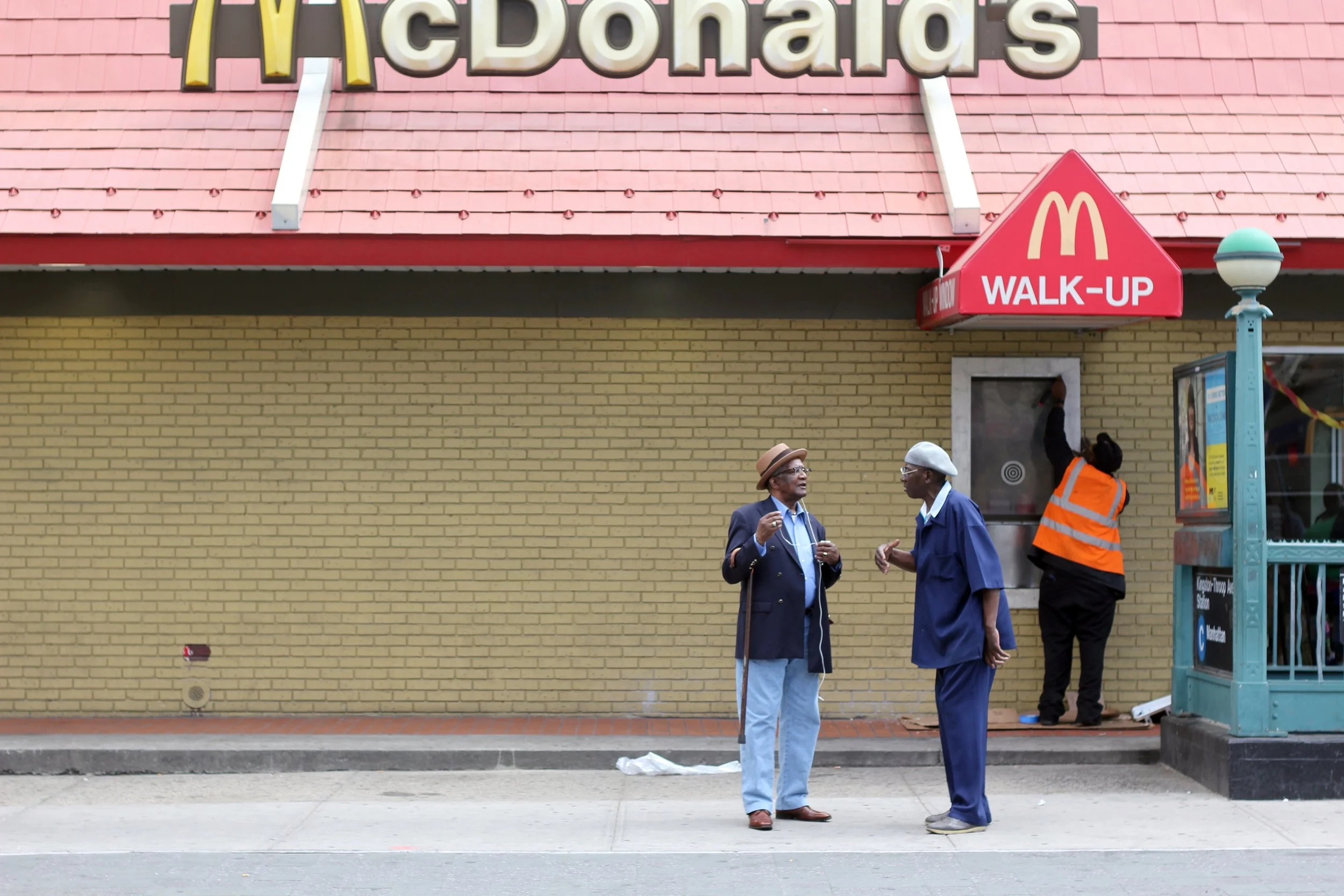
“You remember American cheese?” Radcliffe “Ruddy” Roye asks the elderly man who stands, bespectacled and cane in hand, next to the supermarket advertisement on 132nd and Lenox. Roye recalls it as a budget staple and they joke about government cheese.
The simple signage, “American Cheese,” offers a caption to Mr. Skerritt’s almost-smile, just the kind of found title Roye loves—provocative, with many layers of interpretation.
Written on a card around Skerritt’s neck is information about the book “The Transatlantic Slave Trade” by James A. Rawley, which Roye copies down at Skerritt’s recommendation. Skerritt is a photographer himself, it turns out, and he says his images of Harlem, where he’s lived all eighty years of his life, reside in the Library of Congress. He and Roye photograph each other – it’s the first digital Skerritt’s ever taken – and after thanking him, Roye continues down Malcolm X Boulevard toward 125th Street.
Roye, originally from Jamaica, learned to use a camera in his late twenties—until then, he’d been a journalist. Loading up his Nikon N90 with Sensia slide film, Roye documented the shacks that had popped up along an abandoned train line, walking from Montego Bay to Kingston. He learned to take photographs in the process.
Since then, Roye has worked for the Associated Press and has photographed for Ebony, Essence, Jet, and Vogue. But most recently he’s become known for his work on Instagram. Roye continues to walk and shoot, observing a subject or scene he wants to capture as he wanders, and waits for the perfect shot.
With more than 100,000 followers, @ruddyroye is a self-proclaimed “Instagram Activist,” “peeling the cornea off his eyeball to share” images from his phone and, lately, a Sony A7r. The New Yorker picked up his feed in the aftermath of Hurricane Sandy and commissioned him to cover the New York Marathon last fall, as well as Black History Month of this year.
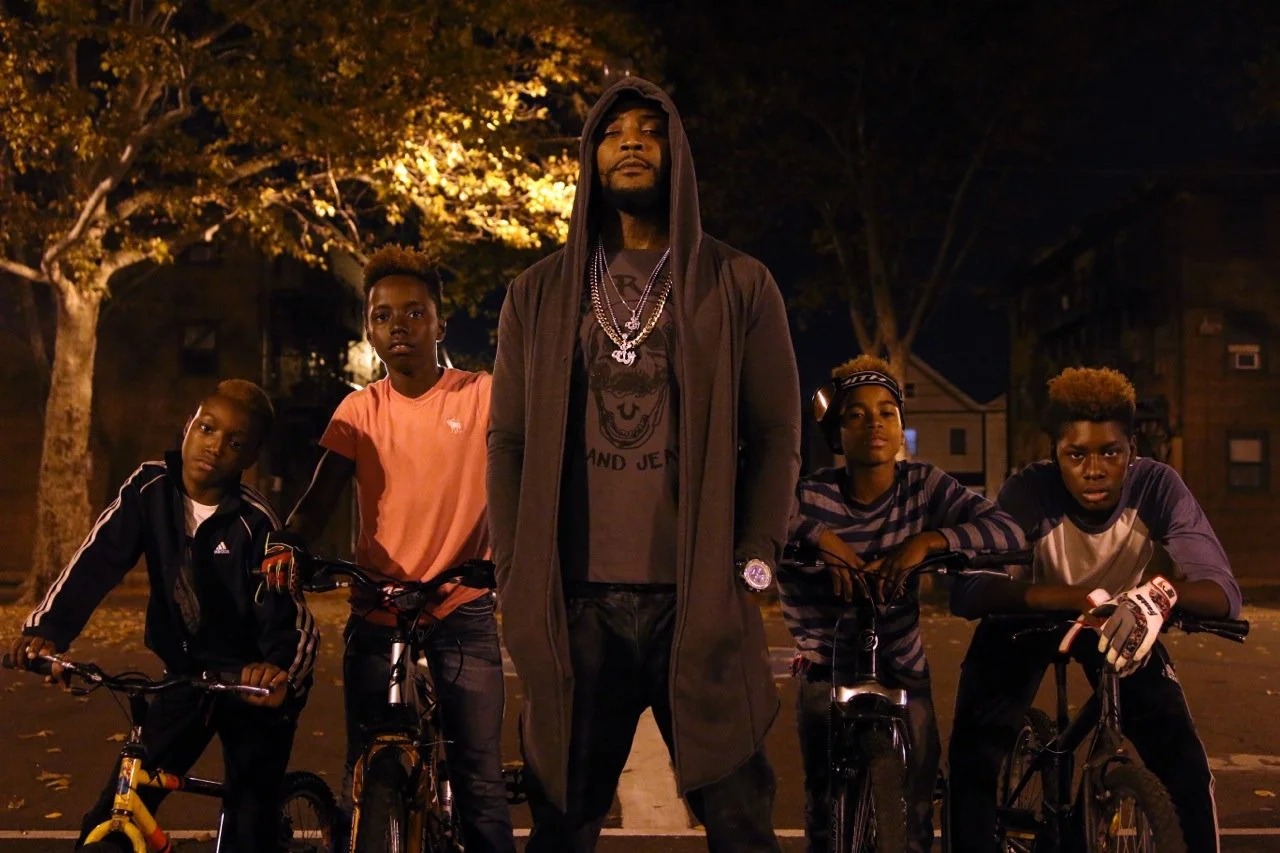
Roye’s #bedstuyportraits, in the neighborhood where he’s lived since 2001, is one of his largest Instagram collections (other frequent hashtags include #blackportraiture, #streetphotography, and #documentary). The formal influence of Richard Avedon is clear in Roye’s portraiture, brazen and fiercely compassionate – Avedon’s photo series, “The American West,” especially comes to mind. Enhanced by Instagram and Snapseed effects; the styles of James Van Der Zee and Roy DeCarava echo through Roye’s documentation of city life.
No matter where Roye photographs – from Brooklyn to the post-Katrina American South, from Kurdistan (where he recently met survivors from the Iraqi-bombed city of Halabja) to the farms or dancehall sessions of Jamaica, from Jouvert’s horned and painted revelers to the dandy-styled Congolese Sapeurs – Roye incorporates a moment’s pause to hear the story of his “collaborators,‘‘ the term he uses to refer to his subjects.
Roye’s captions on Instagram, often a few hundred words long, tell the transcribed stories of his collaborators, along with Roye’s own observations or poetic reaction to the exchange. “When I see, I see a story,” he said of his distinctive captions. I see the potential of the individual to give me a story, and that’s how I compose, with a story in my head. We sit down and I do my writing. I don’t think one could exist without the other.”
On January 13th, of a series showing teenage boys daringly diving into the Kingston Waterfront, Roye writes, “It’s how young boys from the inner city grow up. A kind of street rite of passage, where one’s achievements knit one’s legend.” He reminisces about growing up with a similar “perfect mixture of fun and fear.”
Roye mentions Carmen McLawrence, a woman he photographed while walking Brooklyn with Kevin Bubriski, a photographer and professor who recently hosted Roye as a visiting artist at Vermont’s Green Mountain College. “It’s me wanting, not just to document somebody’s face, but to hold that face with a story for as long as I can,’’ Roye explains with his soft Jamaican inflection.
Roye spoke with Carmen about her Jamaican roots, her mental illness, and her discomfort in this country. “I feel responsible for this image and this story,” he tells the audience during his Green Mountain lecture. “Sometimes I smile to myself because I’m thinking, for as long as I continue to do this, Carmen has life. And it’s one of the reasons I continue to go out everyday to tell stories.”
In his caption, Roye describes Carmen’s striking appearance and quotes her speaking longingly of home. “The sweet, dark, molasses coarseness of her patois brought me back to my days running around in the canefields of my mother’s home in St. Elizabeth,” Roye writes of Carmen. “Her smile dripped like cane juice from her face as she spoke.”
Poultney, Vermont (population 1,600) is starkly different from Roye’s usual locations of, say, Bedstuy or Kingston. In class with Bubriski’s students, Roye engages the undergraduate photographers with honest critiques and animated praise, a long drawn-out “Maaahd!” in response to a truly thrilling image or question. Only a month into the semester, their work is impressive.
During his lecture, Roye describes one reaction to his increasingly “milky” Instagram feed that week (featuring Ray Wood, bluegrass guitarist, roofer and gold prospector, among others). A friend had noticed his change of place, “but your images still have soul,” he’d told Roye, who replied, “Funk has the same smell no matter where you go. And I did get a degree from George Clinton.”
Roye’s work puts forth the funk: his images question and subvert mainstream notions of identity, representation, and perception. His captions offer sharp commentary on poverty, inequality, and injustice, of humanity in the face of institutional oppression. And because Roye’s collaborators have historically been ignored or misrepresented, his captions further ward off potential stereotypes.
When photographer and fellow Instagram enthusiast Ben Lowy asked Roye, “Do you want to be known as just a black photographer? Do you want to be known as an Instagram photographer?” Roye had to consider.
“Today I looked in the mirror,” he realized a few days later, “and I can’t help being a black photographer. That was the first thing,’’ It is of course telling that the question isn’t posed to white photographers. That Roye’s mostly photographed faces of color both is and is not accidental – his work confronts mainstream understandings of “race” and representation by investigating whose images are valuable and why, who is affected by institutionalized inequality in New York City and how. Of his week in Poultney, Roye says, “I hope I was able to touch lives, open eyes. If one person sees past how they were brought up, how they live …it could be an appreciation of more people outside of your community.”
The second thing Roye noticed when he looked in the mirror, was the difference between paid freelance assignments and his photos on Instagram, which are “something I give freely and with passion,’’ he says.
The two-way gift between Roye and his collaborators is palpable when you watch him converse with someone like Skerritt. Roye’s work is as much about his interaction with his subjects as it is about the image that’s created. The result is a testament to the humanity of the “forgotten people,” as Roye calls them, those he works to make visible – but never to speak for. His is an aesthetic of lived experience, again and again demonstrating that poverty born of injustice does not negate inner value or artistic beauty. “I think I’m trying to say that I am just like you. That there’s no difference between me and you. In all my pictures I’m trying to say that,” Roye explains.
Currently, Roye is working on crowd-funding a book of photographs called “Common T’reads,” (a patois pun on shared paths), as well as photographing twenty-two cities in the post-Obama era, among them Newark, Philadelphia, Atlanta. This month his photos will appear in an exhibit on the lower east side organized by New Yorker photo editor Whitney Johnson.
But while his images are still striking mounted on gallery walls, the essence of Roye’s work is being shared on Instagram. “Art is functional,” Roye said. That stuff in museums? “As soon as it’s in there it’s no longer art, it’s something else. Art needs to be in the community. Everybody needs to use it.”
HYCIDE explores the roles we create for ourselves and those created for us, challenging the status quo while bearing witness to the feared, neglected and misunderstood.
Our Mission: Stories of survival and freedom. No judgment.
READ MORE FROM HYCIDE MAGAZINE